
DIY ORGANIC HAIR OIL: HOW TO SOOTHE AN ITCHY SCALP NATURALLY
Nourish Your Scalp. Moisturize Your Roots. Embrace Your Natural Hair.
By COMBfortable™
An itchy scalp can be frustrating, especially when you're wearing natural hairstyles such as braids, locs, twists, or Afros. Dryness, product buildup, irritation, and certain scalp conditions can all contribute to itching.
While many commercial hair products contain fragrances and other ingredients that may irritate sensitive skin, making your own scalp oil allows you to choose exactly what goes into your hair-care routine.
At COMBfortable™, we believe caring for your natural hair starts with understanding your scalp and choosing ingredients that work for you.
In this guide, we'll show you how to make a simple, plant-based scalp oil using organic ingredients.
WHY DOES YOUR SCALP ITCH?
Before making your own hair oil, it's important to understand what may be causing the itching.
Several factors can contribute to an itchy scalp, including:
- Dry scalp: A lack of moisture can cause tightness, irritation, and flaking.
- Product buildup: Styling gels, oils, and creams can accumulate on the scalp.
- Dandruff: Often associated with seborrheic dermatitis, which can cause itching and flakes.
- Tight hairstyles: Braids, cornrows, and other styles that pull on the scalp may cause irritation.
- Allergic reactions: Fragrances, preservatives, and even natural ingredients can trigger sensitivity.
Although scalp oils may help relieve dryness, they won't treat every cause of itching. In some cases, adding oil can make dandruff or seborrheic dermatitis worse.
DIY ORGANIC SCALP OIL RECIPE
A Simple 3-Ingredient Blend for Dry, Itchy Scalps
This recipe uses lightweight, plant-derived oils to help soften the scalp and reduce moisture loss.
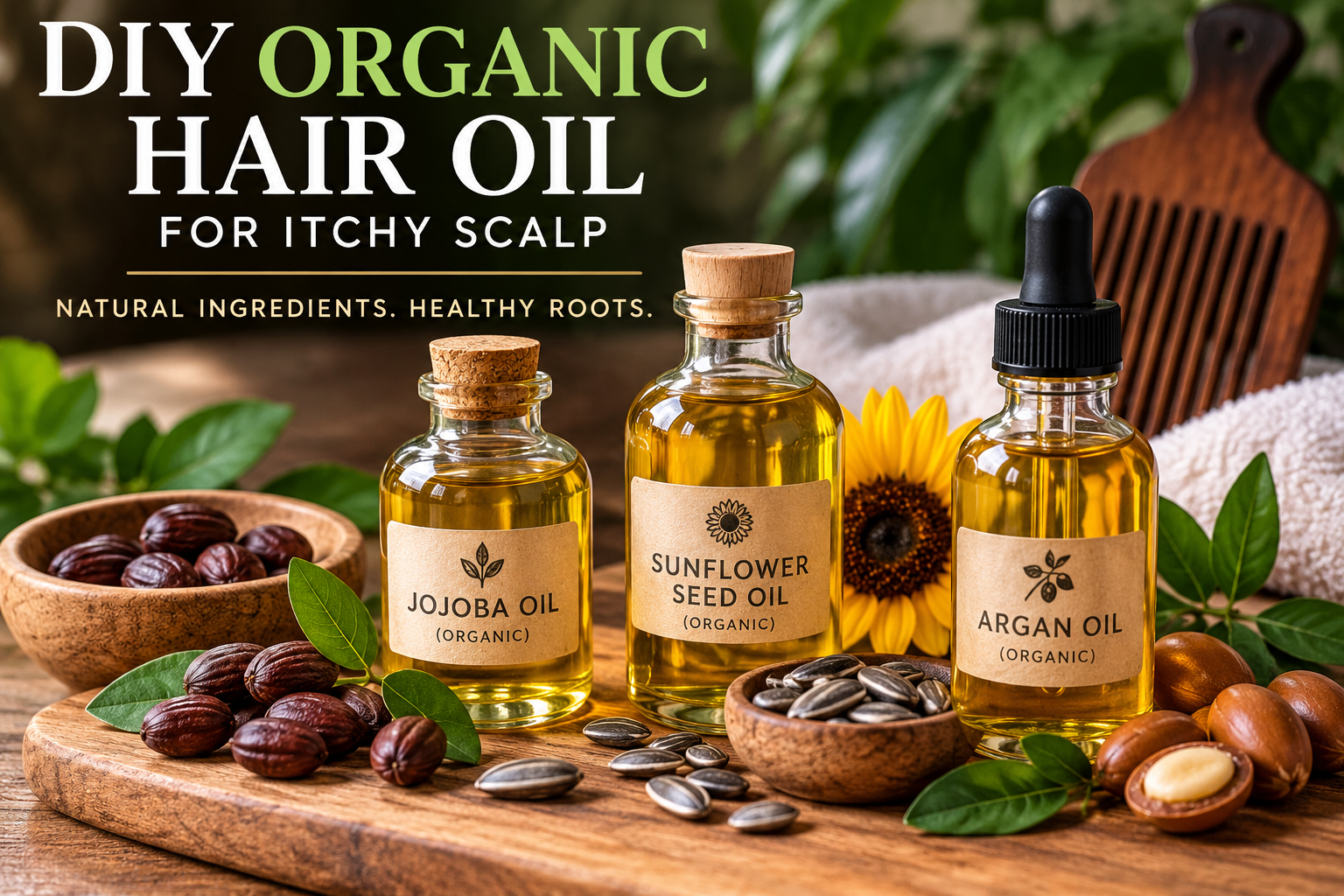
Ingredients
1. Organic Jojoba Oil — 2 Tablespoons
Jojoba oil is technically a liquid wax with properties similar to some of the natural oils produced by human skin.
It can help soften dry skin and reduce moisture loss without feeling excessively heavy.
2. Organic Sunflower Seed Oil — 1 Tablespoon
Sunflower seed oil contains fatty acids that help support the skin's moisture barrier.
It's generally lightweight and can be useful for dry, sensitive skin.
3. Organic Argan Oil — 1 Tablespoon
Argan oil contains fatty acids and vitamin E.
It can help soften hair strands, improve manageability, and reduce the feeling of dryness.
Together, these three oils create a simple, fragrance-free blend for scalp and hair care.
Choose certified-organic versions of all three oils if you want an organic formulation.
HOW TO MAKE YOUR ORGANIC HAIR OIL
Step 1: Prepare Your Container
Start with a clean, completely dry glass bottle with a dropper or applicator tip.
A dark-colored glass bottle is ideal for protecting the oils from light exposure.
Step 2: Combine Your Ingredients
Pour the following ingredients into your bottle:
- 2 tablespoons organic jojoba oil
- 1 tablespoon organic sunflower seed oil
- 1 tablespoon organic argan oil
This recipe makes approximately 2 fluid ounces of scalp oil.
Step 3: Mix Thoroughly
Secure the cap and gently shake the bottle until the oils are combined.
No heating or cooking is necessary.
Step 4: Store Properly
Keep your scalp oil in a cool, dry location away from direct sunlight.
Because this recipe contains only oils and no water, it generally does not require a water-based preservative. However, oils can still oxidize or become contaminated.
Make small batches, use clean hands and tools, and discard the mixture if its smell or appearance changes.
HOW TO APPLY YOUR HOMEMADE SCALP OIL
Applying too much oil can lead to buildup, so start with a small amount.
For Natural Afros and Coily Hair
Part your hair into sections to expose your scalp.
Apply a few drops to areas that feel dry, then gently massage with your fingertips.
Avoid scratching or rubbing aggressively.
For Braids and Twists
Use a dropper bottle to apply a small amount of oil between your parts.
Avoid saturating the scalp, especially if you already have buildup or flaking.
Remember that tight braids can cause irritation that oil cannot correct.
For Locs
Apply a small amount directly to dry areas of the scalp.
Avoid applying excessive oil to your locs, as this can contribute to buildup.
Regular cleansing remains essential for maintaining healthy locs and scalp.
COMBfortable™ Hair Tip
More oil doesn't necessarily mean more moisture.
Oils help soften skin and reduce moisture loss, but they do not provide water-based hydration.
If your scalp feels consistently dry, consider whether your cleansing routine, hair products, or environment may be contributing.
SHOULD YOU ADD TEA TREE OR PEPPERMINT OIL?
Tea tree and peppermint oils are frequently promoted as natural remedies for itchy scalps.
However, natural doesn't always mean gentle or safe.
Tea tree oil has some antimicrobial properties, but it can also cause allergic contact dermatitis. Evidence for treating dandruff comes primarily from specific formulated products rather than homemade oil blends.
Peppermint essential oil can create a cooling sensation, but it may also cause burning, redness, or irritation.
For this reason, our beginner-friendly organic scalp oil recipe does not include essential oils.
A simple, fragrance-free blend is often a better starting point for sensitive skin.
HOW OFTEN SHOULD YOU USE SCALP OIL?
There is no universal schedule for applying scalp oil.
Some people may benefit from using a few drops once or twice a week, while others may not need additional oil at all.
Start with a small amount and observe how your scalp responds.
If you notice increased itching, redness, bumps, or flaking, discontinue use.
Before applying the blend widely, test a small amount on an area of skin and watch for irritation over the next 24–48 hours. A negative home patch test does not guarantee you won't develop a reaction.
WHEN AN ITCHY SCALP NEEDS MORE THAN OIL
Although homemade scalp oils can help with dryness, persistent itching may indicate an underlying condition.
Dandruff, eczema, psoriasis, fungal infections, and allergic reactions can all affect the scalp.
Seek medical advice if you experience severe itching, painful bumps, sores, hair loss, significant redness, or symptoms that continue despite changing your hair-care routine.
For dandruff or seborrheic dermatitis, medicated shampoos or other treatments may be more effective than applying oils.
NATURAL HAIR CARE STARTS WITH HEALTHY HABITS
Taking care of natural Black hair isn't about purchasing the most expensive products or following every new hair trend.
It's about understanding what your hair and scalp actually need.
For some people, a simple combination of organic oils can help manage dryness and improve comfort.
For others, the solution may involve washing more frequently, reducing product buildup, loosening protective hairstyles, or treating an underlying scalp condition.
The goal is to develop a routine that supports your scalp health without unnecessary ingredients or excessive manipulation.
THE COMBfortable™ MESSAGE: LOVE YOUR ROOTS
At COMBfortable™, we believe your roots deserve just as much attention as your hairstyle.
Whether you wear your hair in Afros, locs, coils, braids, or twists, caring for your scalp is an important part of maintaining healthy natural hair.
You don't need a cabinet full of products to begin your hair-care journey.
Sometimes, keeping things simple is the best approach.
Nourish Your Scalp. Respect Your Roots. Be COMBfortable™.
More Than a Tool, a Symbol of a People.
Past. Present. Future. Always.